

How to shrink steering wheel cover safely without damaging the material or the wheel? In this field-tested guide you’ll learn five proven ways to shrink or tighten a steering wheel cover, how to size it correctly, what NOT to do, and when an anti-slip memory-foam option is the smarter fix. Everything below is written for daily drivers, installers, and distributors who want reliable, repeatable results.

How to Shrink Steering Wheel Cover: 5 Safe Methods
Below are the five methods technicians and experienced DIYers rely on. Start with the mildest approach and test in small sections. The goal is a secure, even fit—not a scorched or warped cover.
Method 1 — Warm-Towel Compression (Mild & Paint-Safe)
- Soak a clean microfiber towel in warm (not hot) water and wring it until damp.
- Wrap the towel around a 8–12 inch section of the cover for ~30–45 seconds.
- While warm, compress the section onto the rim with your palms and thumbs; maintain pressure for ~20 seconds.
- Rotate to the next section and repeat around the wheel.
This method introduces gentle heat and moisture so polymers relax and “hug” the rim tighter, then set as they cool and dry. This mild heat-and-pressure trick is one of the safest ways when you’re learning how to shrink steering wheel cover at home.
Method 2 — Low-Heat Blow Dryer (Controlled, No Hot Spots)
- Set a hair dryer on LOW. Hold 20–25 cm (8–10″) away from the cover.
- Keep air moving; warm each 10 cm (4″) span for ~20–30 seconds.
- Immediately press the warmed area into the rim; maintain pressure until cool.
Always keep the nozzle moving to avoid hot spots; you want uniform warmth, not “cooked” patches. With controlled airflow you can fine-tune how to shrink steering wheel cover without hot spots or burns.
Method 3 — Warm-Water Softening (No Electrical Heat)
- Prepare a basin with warm water ~40–45 °C (104–113 °F).
- Dip only the cover’s inner edge for 30–60 seconds. Do not soak foam pads.
- Lightly towel off and reinstall; massage the perimeter evenly while it cools.
This helps the inner lip soften and conform; as it dries, the circumference settles slightly smaller. If you prefer a no-heat approach, this route explains how to shrink steering wheel cover gently and evenly.
Method 4 — Inner-Diameter Insert (Tighten Without Shrinking)
Some covers are simply sized a bit large. A thin, continuous insert placed between the rim and the cover (e.g., a 1–1.5 mm closed-cell foam or TPR band) increases effective rim diameter so the cover sits tight.
- Cut a continuous band to your wheel circumference; secure ends with thin tape.
- Test fit in one quadrant first to confirm thickness before committing.
When material shrinkage isn’t ideal, this insert trick is still part of how to shrink steering wheel cover safely—by tightening fit without stressing the cover.
Method 5 — Swap to an Anti-Slip Memory-Foam Cover
If a cover repeatedly loosens, upgrade to a design that combines an anti-slip inner liner with cushioned pads. Our 6-section memory-foam model is engineered to “lock in” comfort and grip.
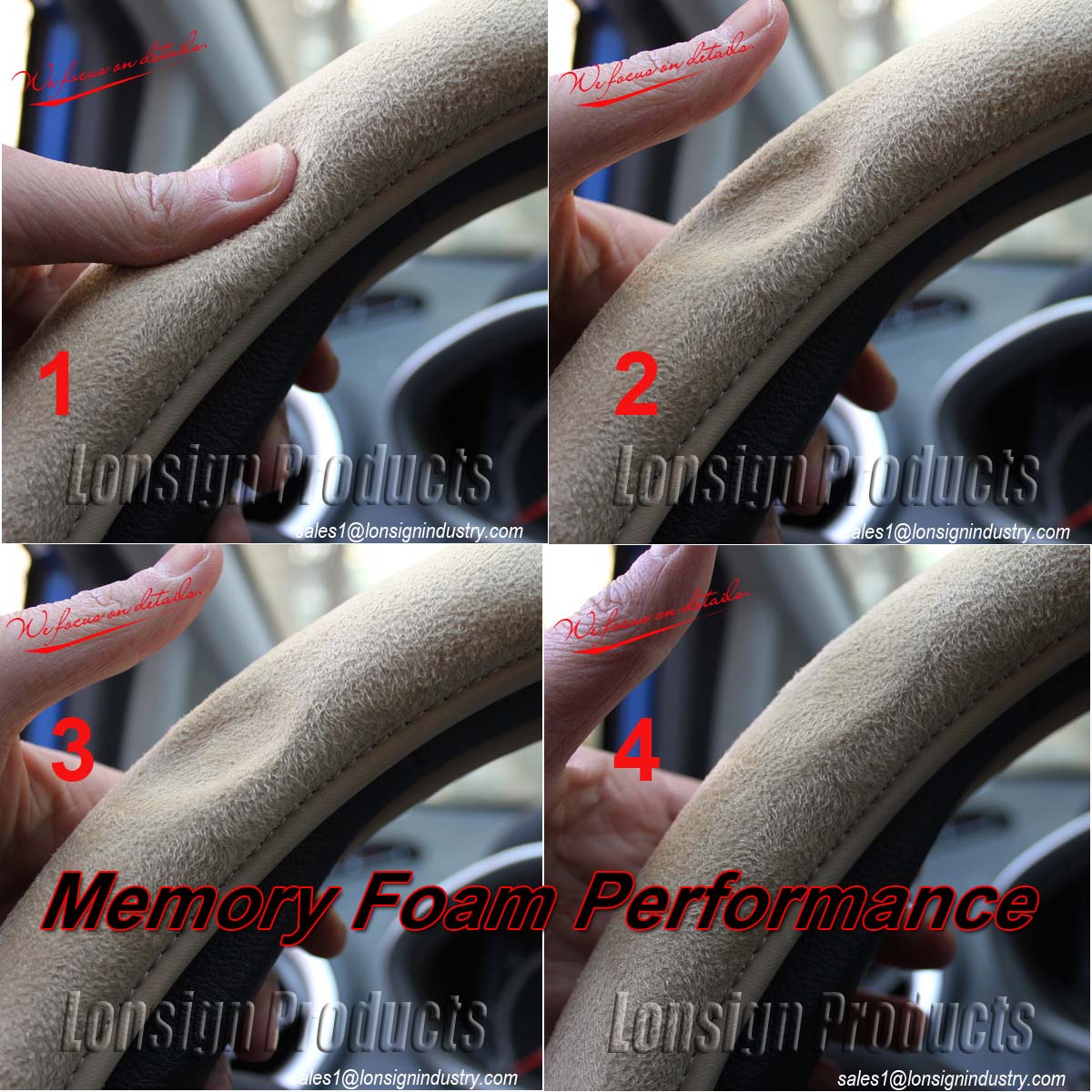
Memory foam conforms to your palm, spreads pressure, and the anti-slip liner helps the cover resist rotation. Instead of chasing micro-shrinkage, you get a stable, comfortable grip. Explore the full specs here: Memory Foam Steering Wheel Cover.
Sizing Guide: pick the right diameter first
Most passenger vehicles fall into two universal sizes. If a cover is one size too large, no amount of heat tricks will make it perfect. Check your wheel diameter (edge-to-edge across center) and rim thickness; then use the table below.
| Cover Size | Typical Fit | Examples |
|---|---|---|
| 14.5″–15″ (≈ 36–38 cm) | Most sedans, hatchbacks, compact SUVs | Civic, Corolla, Camry, Focus, RAV4, CR-V |
| 15.5″–15.75″ (≈ 39–40 cm) | Larger SUVs & crossovers, some MPVs | Highlander, Pilot, Explorer, Tahoe |
| Heavy-duty sizes (42/45/47/50 cm) | Vans, trucks, bus & coach (commercial) | Fleet, school bus, intercity coach |
Material notes: what can and cannot shrink
- PU leather / faux suede: responds slightly to warmth + pressure; safe methods above apply.
- TPR/elastic inners: can recover a little tension with gentle heat; avoid overheating.
- Genuine leather: sensitive to moisture/heat; keep temperatures lower and condition afterward.
- Memory foam pads: don’t “shrink”; they compress and recover—choose anti-slip liners instead of forcing shrink.
What NOT to do
- Do not use heat guns, open flames, or boiling water—these cause warping, hardening, or delamination.
- Do not bake a cover in the oven or leave it under direct summer sun behind glass to “shrink.”
- Do not apply solvents or strong cleaners to speed drying; they break down adhesives and foams.
Avoid risky shortcuts; understanding what NOT to do is half of how to shrink steering wheel cover safely.
Installation checklist (so the fit stays tight)
- Clean and fully dry the steering rim (degrease if necessary).
- Warm install (room-temp or slightly warm cover) for best pliability.
- Seat the top first, then work both sides down, finishing at the bottom.
- Massage the perimeter to equalize tension—no twists or gaps.
- Re-check after 24 h; minor re-massage around spokes evens the fit.
Colors & private label options
Popular colors include Black, Graphite Grey, Beige, Coffee, Wine Red, and Blue. We support custom threads, logos, and retail packaging. Historically, our slow-rebound line has performed strongly in retail—one campaign for a major chain sold 360,000+ units in a single order window.

Safety & compliance resources
Any modification around the steering wheel should preserve full control and airbag clearance. For general vehicle maintenance best practices, see the official guidance from NHTSA (U.S. National Highway Traffic Safety Administration). Always follow your vehicle’s owner manual.
FAQ
How to shrink steering wheel cover if it feels loose?
Confirm diameter first. If correct, use low-heat blow-dryer warming or the warm-towel compression method in small segments. If the material hardly responds, use a thin under-ring to tighten the fit—this avoids over-heating and is reversible.
Will shrinking damage the cover?
Not when done gently. Damage happens with excessive heat, soaking pads, or harsh solvents. Keep temperatures modest and test on a small area first.
What if the cover keeps slipping?
Choose an anti-slip liner or step up to a cover designed to grab the rim—our Memory Foam Steering Wheel Cover combines a grippy inner with cushioned pads, so the wheel feels secure without constant re-work.
Ready for a no-slip, cushioned upgrade? See specs, sizes (36–38 cm and 39–40 cm), and heavy-duty options here: Memory Foam Steering Wheel Cover – Lonsign. If you sell retail or manage fleets, ask us about private label, colorways, and bulk lead times.
Bottom line: When you know how to shrink steering wheel cover safely—mild warmth, even pressure, correct sizing—you can rescue a slightly loose fit. But if you want long-term comfort and secure grip with less fuss, switch to a memory-foam anti-slip cover and enjoy the drive.